Storycraft: The Key to Renaissance Faire Growth
By Leigh Owens
Everyone loves a romanticized version of past eras and imagining themselves in them. The Renaissance Era offers the added bonus of room for a little escapist fantasy magic. Who doesn’t want to wear fancy clothes and talk to a dragon or a fairy or a pirate? Everyone loves a good story.
However, even with the perfect setup for the perfect setting, running an event in our modern era can offer many challenges. Consider the aspects of these three elements in building the story for your Faire.
1. Know Your Audience
Every good storyteller knows to start with their audience. But what exactly does it mean and how do you do it?
In the case of a Renaissance Faire, many people will want to come. The Louisiana Renaissance Faire draws tens of thousands each year. That’s a lot of people to appeal to.
However, understanding why people generally might enjoy a Ren Faire is not nearly as useful to you. You need to understand the demographics in your area specifically and why they find a Faire appealing. You can determine what your demographic focus should be by looking both internally and externally.
If you’re just starting a Renaissance Faire, you’ll focus on your external audience as you build your own internal audience.
Talk to Your Internal Audience
In order to look internally, you must have a way to collect demographic data. Most third party registration assistants such as Stride Events can do this for you. Stride Events specifically offers ticket heat maps and data on which days and special events or shows are selling better.
You can also gain more information about your attendees by sending post-event surveys, which not only can garner you more information about their demographics, but their experience and their thoughts and feelings on it. We’ll discuss attendee feedback a bit more later.
Research Your External Audience
Familiarize yourself with what other events and entertainment are available in your area, and what has thrived and if there are past events that have withered.
If the nearby area includes a lot of families with an emphasis on wholesome, family-friendly activities, emphasize activities that appeal to children and families.
If there are more single adults, you might put more of an emphasis on alcohol and artisanal goods.
Maybe local folks like a heavier emphasis on the historical aspect of the Renaissance Era.
Or, if your local game shops are particularly active, introducing more space for LARP style engagement might be a better fit.
The following sources, when available, can offer a lot of insight:
- farmer’s markets and craft fairs
- local breweries
- local museums and art galleries
- local libraries
- local rec centers
- city event pages
Ask yourself if there’s other noteworthy establishments in your city or nearby cities and if they hold events. Don’t be afraid to go and talk to people. Use all of this information about what else is successful to adjust your own approach.
While it might seem that casting a broader net would bring in more participants, it’s important to recognize that without a targeted appeal, fewer people are going to say, “This is for me.”
Some audiences can clash in what they want out of an event as well (such as childless adults looking to cut loose and relax, and families looking for child-friendly environments) making it difficult to appeal to both, especially if your Faire is on the smaller side. Know who your actual audience is and appeal to them specifically.
Looking externally will also help you determine when to hold your fair. Renaissance Faires are usually held during warm months, when school is out and people don’t mind being outside.
However, are there any other events that might conflict and compete with yours? Are there any portions of the calendar that are completely bare of entertaining events?
Potential attendees have limited resources, so if your event is close to when other events are, especially other Renaissance Faires, you lose your customers to other events.
In the case of other Faires, you may also struggle to have guilds, performers, and acts attend your Faire if they have to choose between yours and another. Part of knowing your audience is knowing what their schedule is like.
If you feel that there might be an oversaturation of Renaissance related attractions in your area, consider a slight shift in your theme, such as a Celtic or Highlander Faire or a focus on Vikings. If your theme isn’t quite right, external research can help you tweak it to something more appealing.
2. Engage Your Audience
It’s easy to say keep your audience engaged, but how is it done? A skilled storyteller has an opening line that jumps out to their audience.
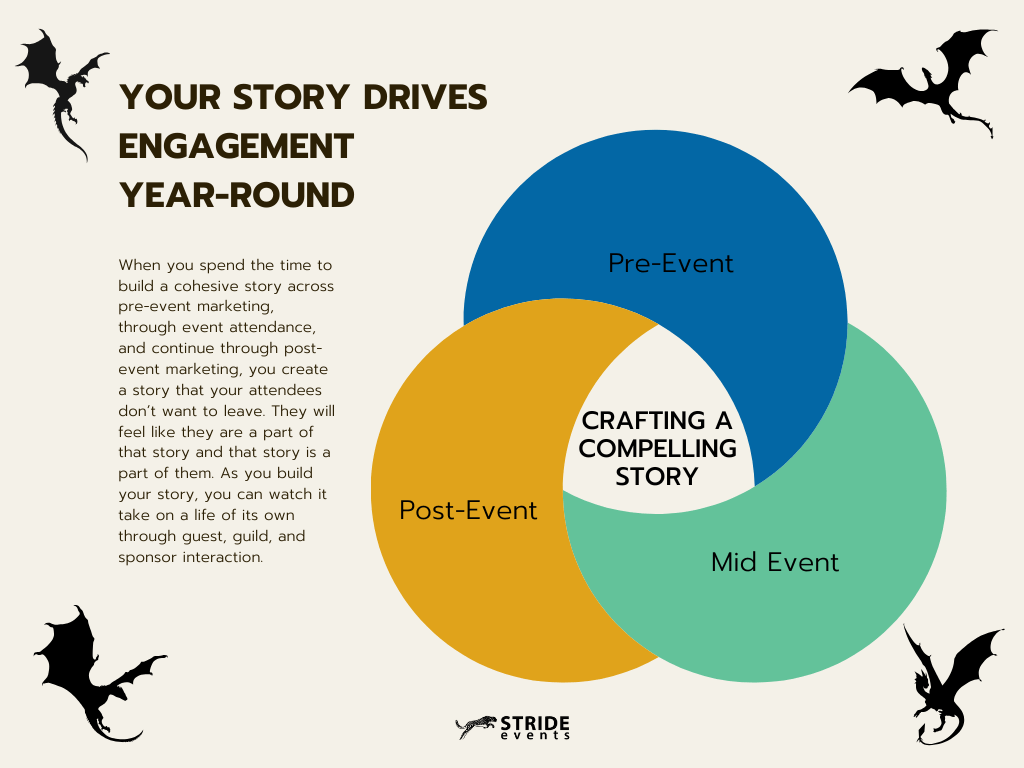
Begin with the way you advertise your event - even, “Come experience the magic of our Renaissance Faire” is a more interactive tag line than, “Come to our Renaissance Faire.”
As you think of taglines and advertising messages consider:
- What sorts of guilds, attractions, and actors do you have at your faire?
- What sort of artisans and booths?
- Are there pirates? Fairies? Ghosts?
- Will there be public drama in the royal court?
- Can knights be seen outside of the jousting arena?
How can you incorporate these stories into your advertisements?
Once you have determined the story you want to tell your audience, you will want that story to permeate your other interactions with participants. Customize your messages to your customers for confirmations, reminders, and instructions to carry your story. They should also be personalized and include the name of the customer.
Stride Events offers free mass email that makes custom messaging and email design easy. Your confirmation messages can offer extra engagement with information about the venue, such as a map, event itinerary, information on parking, accessibility options, and other nearby amenities. (For example, ATM locations are important if you don’t offer any at your site.)
Create an Informative Landing Page & Simple Ticketing
When there’s too many pages or buying tickets is too confusing, customers lose interest and drop out. Keep ticket purchases and registration straightforward, and you’ll retain more customers.
Likewise, your marketing page should be simple enough that customers can find what they want quickly. No one likes long, boring exposition, so it should be short and simple to locate all the information about your event, including address, features, and reviews.
Create an early-bird pricing strategy to create a sense of urgency and encourage ticket purchases.
Consider simplifying with a ticket manager, such as Stride Events, which can provide a straightforward and informative marketing page, makes Early Bird pricing simple, and offers a simple and straightforward purchasing process.
Reward Attendees for Telling Your Story
Have you ever wondered why tabletop RPGs like Dungeons & Dragons suddenly became extremely popular?
Part of it is because they were recognized as a form of communal storytelling. Storytelling is an ancient part of human behavior. Communal storytelling draws people to Renaissance Faires, too. People like to feel part of something.
While you should be creating an environment that allows attendees to be part of that storytelling at your Faire, you can encourage attendees to tell your story before they even arrive, and after as well. Once you’ve started a story with your marketing, give the customer space to fill in more of the story with themselves.
One way you can do this is by asking an engaging question and encouraging guests to respond while sharing the post. Another is by using a referral program. Perhaps you can flavor the referrals as recruitment for teams or factions: Wyrms vs Unicorns or one region versus another. You can use Stride Events to easily add in and track social media sharing promos and an adjustable referral reward system.
Partner with Sponsors
Engaging an audience’s community is a way to engage them. Sponsors are an excellent option for growth as when done right, everyone benefits.
A sponsor’s support is pure revenue for you. Ad space at your Faire is marketing for the sponsor that shows they’re involved with the community and boosts their reputation. Sponsorship perks for your guests leaves them with a positive feeling about both your Faire and the sponsor.
To set up this lucrative partnership, consider what you can offer potential sponsors. The more creative you can get, the better!
Visibility is important, but so is immersion, so that your audience doesn’t feel like the sponsor is intruding on their frivolity. Perhaps sponsors can sponsor a knight, or charter pirates. When the local dentist or supermarket becomes part of the story, they feel more like a participant themselves and less like an ad.
The final piece is determining how the sponsors can improve a visitor’s experience. Sponsor perks should consider the circumstances of the Renaissance Faire. If the Faire is someplace hot, they could offer sunglasses or hand fans. Or if your Faire is during chillier weather, hand warmers are an option. Perhaps food stalls might carry complimentary moist towelettes courtesy of - and branded by - the sponsor.
Offering different sponsorship packages will allow you more versatility in what sponsors can support you. Creativity is required to invent both perks for sponsors and from sponsors. Keep track of who your sponsors are, what levels of sponsorship you offer, and what perks they offer more easily with Stride Events, which makes signing up as a sponsor simple.
3. End on a Cliffhanger
When your attendees leave, you want them to still be talking about the event.
Leverage Social Media
Year-round engagement creates excitement and encourages your attendees to become a community. Create a dedicated hashtag for your event on social media, something easy to remember but specific to your Renaissance Faire. Determine what kinds of posts can keep your audience’s attention.
Posting good quality photos is one obvious step. However, consider something like a riddle or a question. Post a picture of a scene at the Faire and ask people to give suggestions on what is being said or what the context for the picture is. For example, if you had a jester with displeased patrons, you could ask what joke the jester had told.
Lighthearted contests, such as showing off your best Renaissance garb or sketching up what a guardian dragon might look like, are another way to engage your community.
Contests can be enjoyable to participate in just for the fun of it, but engagement will work better if there is a small prize attached to it, such as a minor promo code or a small trinket. Make sure that if you’re using a ticket manager, it’s able to support both promo codes and social media promos, like Stride Events.
Build a Community
Requesting attendee feedback is another way to continue the conversation afterwards. With an event like a Renaissance Faire where building community is an important part of the process, attendee feedback is a major part of how attendees feel like they’re a part of that community. This is where post-event surveys come into play. Stride Events allows you to easily build a custom review form and with its free mass mailer, it’s simple to send out the link to attendees.
Of course implementing any of that feedback requires judicious review, but it’s an essential resource for determining your weaknesses, fine-tuning the festival, and encouraging ideas.
Techniques for social media shares and referrals can continue after the event. If you did not want to have factions at the Faire, you can encourage shares with votes for less meaningful teams, where it’s simply declaring an opinion.
When you’re running a Renaissance Faire, you’re selling an experience. The experience is more powerful the more immersive it is. So every way you can find to immerse people, even outside of your faire, even entire third party businesses, the more you prove your storytelling ability is potent enough to provide an experience worth remembering. This is what will attract patrons, guilds, acts, and sponsors alike.